Showing posts with label Dharamshala. Show all posts

Thursday, February 14, 2019

Dharamshala reels under scarcity of parking spaces


Traffic jam near Kacheri Junction in Dharamshala (Image Credit: Shubham)

 Dharamshala: Despite being selected to be developed as a smart city, Dharamsala is yet to have enough parking spaces in the city limits. Though a new parking lot has just finished construction in the DC office compound, it is limited in capacity.

Baldev Guleria, the guard who takes care of the parking lot in the DC office, says that when traffic increases the place gets filled easily. "This parking lot is too small and gets filled up easily when the traffic increases'', he said. The parking lot can accommodate only 60 cars.

Most of the hotels have no parking available and even government offices have insufficient parking. Due to this, in most places in the city limits and the adjoining tourist spots, vehicles park on the road side, often causing traffic jams, especially on peak days.

         "Dal Lake is a good place but for tourists, there is no area for parking available. The vehicles of tourists have to be parked on the roadside,'' said Nikita Patel, a tourist from Gujarat. Especially after the recent snowfalls, road to Naddi and Dal Lake got choked with traffic jams on weekends as hundreds of tourists poured in to enjoy the snow. In the absence of parking space, vehicles parked on the side of these narrow roads holds up the entire traffic. “My family members had to wait for an hour in the car to reach the tourist spot, due to the traffic jam”, says Nikita.

This is also affecting the local business as well. According to Saurabh Thakur, one of the owners of Thakur Tea Stall near the Police Ground, this cost him good business on certain days. "Due to lack of parking, people are not able to stop nearby to have a cup of tea,'' says he.

The narrow roads are a big issue here, especially during the peak season from May to June, says Vijay Kumar, a traffic police officer in Dharamshala. “There shall be one way system in the city to improve the situation”, says he. Many shop keepers feel that the parking problem in Dharamshala and nearby tourist places such as Dharamkot, Bhagsu Naag, Dal Lake, Mcleodganj, and Naddi could be eased by developing some more parking areas.
     
The absence of parking spaces has also resulted in people getting used to parking by the roadside. "More parking lots are needed but strict rules are also required as in case of other smart cities like Chandigarh”, says Vijay Kumar. “In those cities, police quickly takes away vehicles which violate parking rules”, he said.

A tank which stands on its knees in the honour of our soldiers in Chawinda


The M47 Patton Tank captured from the Pakistan army during 1965 conflict, on display at War Memorial Dharamshala (Image Credit: Manish Gupta)

by: Manish Gupta

Dharamshala: “The M-47 Patton tank captured from Pakistan during the 1965 war is like a medal for Indian Army”, says Col KKS Dadwal (Retd), the current chairman of war memorial in Dharamshala about the battle tank on display at the memorial.


According to Memorial officials, it belonged to the 6th Armoured Division of Pakistan Army and was among the tanks captured by the 1st Armoured Division of Indian Army in the battle of Chawinda in one of the largest tank battles after World War II. Also used as MBT (Main Battle Tank), the M47 Patton tanks were the most advanced tanks during the period. During the 1965 conflict, India has destroyed 471 Pakistani tanks as per official estimates and captured 38 of them.


“The tank’s barrel is kept low as it is the practice with captured tanks”, said Col KKS Dadwal. The tank on display at the Dharamshala war memorial, the only War Memorial in in Himachal Pradesh, is a center of attraction for the visitors. The tank on display has a 90 MM main gun capable of firing 71 rounds with the in-tank ammunition. Weighing 44.1 tons, it had an operational range of 100 kilometers and a maximum speed of 40 KMPH.


“We are taking care of it with honor and a feeling of patriotism”, said Ashok Sharma, who works as a clerk at the memorial. “Visitors come from faraway places to pay their respects to the martyrs”, he added.


“This tank is like a war trophy which our solders got by sacrificing their lives and I am proud to have a look at it,” said Aman Deep Singh, a tourist from Punjab.


Named after General George S Patton, an exponent of tank battle, who commanded the US Third Army in World War II, Patton tanks were considered formidable weapons till 70s. The 1965 Indo-Pak conflict became the first real combat test for Patton tanks and it did not turn good for it. During the conflict, Indian army decimated more than 97 Pakistani tanks in the Khem Karan- Asal Uttar battle on 10th September 1965. According to US war historian Steven Zaloga, more than 65 of these tanks were M47 & M48 Pattons. The place and the battle later came to be known as the ‘graveyard of Pattons’.

Wednesday, November 28, 2018

Dharamshala's Zonal Hospital lacks basic facilities

by: Umang Arora


Pallavi, a student of Central University of Himachal Pradesh, had suddenly fallen ill in the middle of the night. Her friends called every number possible, from emergency number provided by the Dharamshala Zonal hospital to 108, the Emergency Response Number. But there was no response on the other side of the phone. At last, they called Dharamshala Police Station and asked them to help their friend.

“Pallavi had an epilepsy attack at midnight. She was with us, at our room. We had to take her to the hospital”, said Kuldip*, her friend. They were facing such a situation for the first time and that too at the middle of the night. They frantically kept trying emergency numbers but found no response except from police.

Getting reliable and emergency medical help at Dharamshala is not easy, especially at odd hours. The Zonal Hospital, despite being the only major medical facility available for more than a dozen villages around Dharamshala is not in a good shape. Even basic services are lacking. Patients visiting here have to go through various challenges to get proper treatment.

"We're here since 8am and the doctor hasn't arrived yet." said the member of a family that came from Bandi, a small village in Kangra. Their son was suffering from high fever and even after waiting for 5 hours, there was no doctor to examine him at the Emergency ward. Members of another family from Gharoh, a village near Dharamshala, said they also faced the same situation.

The winter has arrived in the city and there's a hike in the number of patients. However, the doctors wouldn't arrive in the Emergency section till noon and there's no one to guide the patients. The help desk is there, but no one has ever been seen sitting there. The washrooms aren't properly maintained. At some, there're no lights and at others, there's not even partition among men's and women's washrooms.

It is not that the medical staff here does not want to take care of the patients. They also face issues. “The call on 108 goes to the Solan first, and then the ambulance is provided to the patient. Often, this causes delay, especially during odd hours”, said a hospital staff. “We’re trying our best to satisfy the patients with whatever resources available,” she said.

The Zonal Hospital is the only secondary care multispecialty hospital in the Dharmshala sub division in Kangra district. It is equipped with a 300 bedded In-patient ward and a total of 90 staff. According to sources, there’s a shortage of doctors in the Zonal hospital as of now. Most of the patients are being referred to Tanda Medical College due to this.

Randeep Singh Rana, a labourer, hailing from Dari, had fallen sick in the middle of the day. His family took him to the hospital. "The doctor didn’t even touch him. Such was his carelessness. We were not satisfied by the services of the hospital and had to take him to a private doctor." said his uncle.

People are just not satisfied by the hospital's services. Many complained that the hospital staff was very rude towards the patients and their families. Patients are forced to resort to continuously coax the emergency staff to get the essential medical help here.

For Pallavi’s friends, even getting police help to take her to hospital was not easy. The police tried to put their request off by asking them to wait till morning. “We even had to warn them that if something happens to Pallavi, they’ll be responsible”, said Kuldip. “Then only they came with a vehicle to help us”, said he.


*Name changed on request for privacy reason.

New efforts aim to restore Kangra miniature tradition


Radha celebrating Holi, painting, c.1788 (Image Credit - Wikimedia)

By: Preshita Thakur
Those who want to get a deeper experience of the traditional art of Himachal Pradesh at Dharamshala has a better chance now as the Museum of Kangra Art in Dharamshala is soon going to accommodate more of the Kangra paintings. The on-going renovation of the museum aims at increasing the space given to Kangra miniature paintings, told the museum authorities.

It will take another two to three months for the completion of construction. “After the renovation, we will bring out more paintings from bigger names including Padma Shri awardee Vijay Sharma and other senior artists”, says Dr.RituKumari, curator of the museum.

The museum, run by the Language and Culture Department of the state government, is one of the major art galleries in the area dedicated to Kangra miniature paintings. The museum also used to conduct training sessions on Kangra painting in collaboration with Kangra Arts Promotion Society (KAPS), an NGO working for promotion of Kangra art. The classes have since moved to Mcleodganj, due to the ongoing construction activities at the Museum.

Museum of Kangra Art in Dharamshala
 As part of their initiative to preserve the tradition of Kangra miniature paintings, KAPS has opened ‘Chitera’, an institute to train budding painters in the traditional Guru-Shishya parampara of Pahari paintings. Most recently, they have inaugurated a new space in Mcloedganj, an art gallery to exhibit works by its artists.

There are many renowned artists as well who are associated with the museum, practicing and teaching directly from the temples nearby. Dhani Ram Khushdil holds a clerical post at the Brijeshwari Temple but also teaches students interested in Kangra paintings for free. “I want to pass on this great tradition to the upcoming generation,” says he.

Kangra Miniature painting has its history rooted far back in the 18th century. It is still practiced today, though the exposure is limited. With all the above efforts, there is hope for better results in reigniting the glory and status of the paintings and its artists.

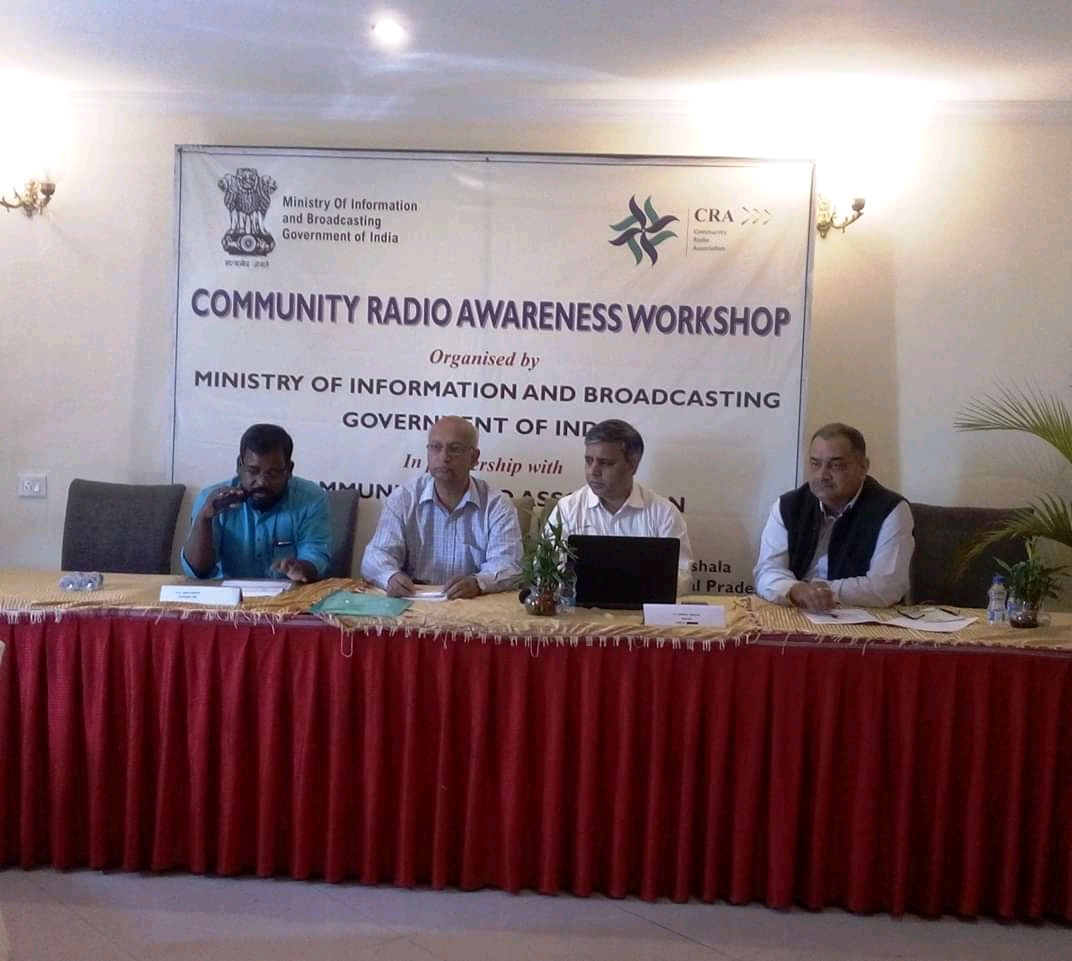
Community Radio workshop held in Dharmashala


Participants in the community radio workshop in Dharamshala


by: Shubham Sharma

Dharamshala: There is an increase in the number of NGOs now applying for community radio licenses in India, according to officials of the Ministry of Information and Broadcasting. “In the recent survey, we observe that NGOs are more appreciated for their work in community radio sector and this has inspired more NGOs to apply for licenses”, said Ajay Joshi, Deputy secretary of MIB.

He was speaking at a Community radio awareness workshop in Dharamshala. The workshop was held for promoting the use of community radio and development of grass root community service through community radio.

Community radio Gunjan, located in Shidhbari was one of the organisations that participated in the workshop. Nitika, a member of Gunjan said, “Through culture, we can increase the importance of community radio by giving our message.”

Community radio association office bearers from H.P., Jammu and Uttrakhand participated in the workshop. There were 11 sessions about community radio, which discussed the present status of community radio sector, its technology, policy and application process in India, government schemes and sustainability options.

What winds the Dharamshala commuters most?


(Representational Image)

By Shalini Thakur

Dharamshala: "I think public transport here in Dharamshala is painful. Why would you get on a  Bus that doesn't leave to wherever you want it to head to, doesn't start wherever you want it to start from, and doesn’t stop at where you want it to stop?”, says Preshita Thakur, a daily commuting student at CUHP,who has to travel from Gahlian, a small village near Ranital in Kangra.

There are 3906 villages in Kangra, most of which are not have proper bus services. Many villages have just a couple of buses plying to them daily. When they stops operations unexpectedly, due to bad weather or some other uncertain circumstances , people in these villages and students suffer. Other modes of public transport are not affordable for most.

 ”Buses are our principal mode of public transport to nearby places", says Kuldeep Chand(64), an old man who lives in Dari in the outskirts of Dharamshala with his family. However, bus rides are not always a pleasant experience for him. Bus drivers and conductors often behave rudely or use abusive language, complaints Kuldeep. Elderly people like Kuldeep who suffers from Arthritis and other ailments, finds it difficult to enter and exit a vehicle. "One day when I pleaded to a conductor to give some extra time to get down from the bus, he shouted at me", says Kuldeep.

 “The day I was about to hire a taxi to Indrunag, the taxi driver pitched a price of 300 Rupees, I was totally shocked," says Umang Arora who hails from Jalandhar, but presently stays in Dharamshala for her studies. Umang complaints that she has come across several taxi drivers in Dharamshala who demand exorbitant charges from their passengers.

However, taxi drivers in Dharamshala have their own woes to deal with. The daily rise in fuel prices has made a dent to their daily earnings. “It is difficult if the taxi is your only source of income” Kamlesh Kumar explains. Kamlesh Kumar is a local taxi driver in Dharamshala, who lives with his family in Garoh, a village nearby. He says it is a hard task to maintain a taxi in Dharamshala. "Honestly, the petrol prices affect us very much. Servicing and repairing the vehicle from time to time also affect us and it becomes very difficult to survive when you are the only source of income in your family," says Kamlesh.

People like Umang, who are from cities where app-based taxi services are ubiquitous, finds their absence in Dharamshala bizarre. “App-based taxis back home were very convenient as they can be availed at any time, at any route based on our convenience. Drivers can not demand excessive rates too”, she adds.

Changing Paths: From hacking to rescuing animals


Avni is a three-limbed monkey recently rescued by Peepal Farm. She is recuperating from wounds
 (Image Credit: Peepal Farm)


By Himanshu Sharma

“I don’t think we thank god enough that we are not a dog suffering from severe mange, starving on the streets” Robin Singh exclaims.

He runs Peepal farm, an organic vegan farm and a stray animal recovery center at Dhanotu near Dharamshala.

Peepal farm is spread across one-and-a-half acres of land with an organic farm, an animal facility, cowsheds, and pet homes. The rescue center has a staff of eight, including a veterinary specialist. Thanks to the proximity to Dharamshala, Peepal farm gets lot of volunteers and numerous calls for animal rescues.

 “Initially we treated only dogs and gradually started helping other animals including cows and horses,” Robin explains.

King, a bull, is the newest resident of the animal shelter in Peepal farm. King is under the treatment for the burn injuries suffered when miscreants poured hot water on him nearby Palampur. King is getting familiar to the animal family of Peepal farm which include a monkey, four dogs, 4 bovines and a goat and a sheep. After the treatment is over, majority of the animals are released. Peepal farm also allows people who want to adopt pets to take care of these animals.

For Robin Singh, this is a new incarnation. He used to be a hacker. Seven years back, he was running a successful online business organization in the United States.

“But I was not happy. Later when I arrived in India to travel , I re-connected with my childhood dream of helping animals in distress,” he added.

He visited Auroville, the township near Pondicherry, in 2012 where he helped an elderly woman who was, on her own, looking after 40-50 stray dogs. It was during this period that he realized that he wanted to spend his life helping those who can’t help themselves.

“We look forward to making a group of devoted people who can do great and draw in long-term solutions for animal welfare”, Robin Singh added.

Incubating the untapped film talent in Himachal


Siddharth Chauhan

By Anuj Kumar Pandey

The popular film legacy of Shimla is limited to being one of the favorite locations for not-so-high budget Bollywood productions. Nobody here expects a Shimlite to make marks in world cinema circuits. After all, Himachal was never a soil for serious filmmakers. But with several independent filmmakers  emerging from the hills with their own films, things are for a change, lately.

Growing up in Shimla, Siddarth Chauhan never thought about succeeding in making films that would entice the  world audience. But with multiple screenings of his films in festival circuits outside India, he needs no formal introduction as the independent film maker of Himachal Pradesh.

Siddarth rose to fame when his film Pashi was selected for the Rhode Island International Film Festival, a coveted festival where award winning films would get direct nominations for academy awards, popularly known as the Oscars.

Being a self-taught film maker, Siddarth’s initial training was his rigorous film watching. “I mostly despise action films. I am a fan of coming of age genre”, says he. He admires Indian directors who do not make cookie cutter features.

'Boys Don’t Wear a Nail polish' was Siddarth’s first film. "Making it was a hard task but I always enjoyed the process", he says. He went on and with the help of his mentors such as documentary filmmaker Gurvinder Singh and made further films like Papa and Pashi. He stays in touch with Gurvinder and looks forward to collaborating with him.

Siddarth did not expect a warm welcome to his films from  foreign audiences. “For me, the experience was very unreal. I never expected that my film would get such a good response from the audiences outside India”, he said. "It was jarring and rewarding. The success that Pashi got, especially the whole Oscar thing, put me in a peculiar place" says Siddarth.

Piyush Kanga
Being an independent filmmaker from Himachal Pradesh is a journey Siddarth shares with several other budding filmmakers. Piyush Kanga from Bilaspur had an interest in dancing since childhood and while growing up he knew he could do something in films. Piyush had a little experience in filmmaking or any connections in Bollywood.

His first film was ‘Dost’. He didn't expect it to get him anywhere but just enjoyed the experience of making it. He is currently pursuing his studies and is also busy with his acting assignments. He manages a production house called Silent Hymns Production and continues to make short films.

Being in Himachal, there are several issues these filmmakers face. “The hardest thing to pull off in here is to get actors. Most of them are not professionals and professionals cost a lot of money”, says Siddarth. In Himachal, finding a serious filmmaker is like finding unicorns. “Getting in touch with other filmmakers and learning from them is difficult here”, says Piyush.

However, the film festivals which are mushrooming in the hills lately are encouraging such budding filmmakers. Piyush and Siddarth were both part of the fellowship programme at Dharamshala International Film Festival (DIFF). Similarly, both of these filmmakers have screened their work at ‘International Film Festival in Shimla and DIFF as well.

 "Himachal as a location has always been an unexplored phenomenon. It’s ripe for depiction on screen. If the government supports, then even Himachal film making scene can improve a lot", says Piyush.


Suraj's music tales: Me, my guitar and the Israeli friends


Suraj (second from left) with his friends
By: Sayed Adi Shah Ashraf

With stoopy shoulders and a child-like grin, Suraj Thapa is like any other vendor in Mcleodganj who sells curios to tourists. He owns a small music store here and in the day to day grind of running a store, would sing in the free time. What makes him a tad different from other vendors are his dreams. He wants to buy an electric guitar and become a singer.

Suraj is naturally shy. He pauses for a second when he talks about his dream. He mentions he would have to help out his family regardless of whether he likes it or not. "Guitar or no guitar, I love my family and they love me and I want them to share what I can earn from this small shop ", he says.  “But someday, I will become a singer and will lead my music band. That’s for sure”, tells Suraj as he prepares to close down the shop for the day.

Pursuing the dream full time is not an option affordable to him. Suraj who is the only earning member in the family presently runs the musical store which was earlier owned by his father. His father passed away when Suraj was around 6 years old. So he had to look after his family.
His electric guitar dream stayed a dream until he happened to cross paths with a couple of music loving Israelites. On Off-days, Suraj also juggles the hat of the local tourist guide, especially for foreign tourists interested in exploring Dharamkot. Being a local boy from Dharamkot, he knows the hillocks around like his palm. That’s how he met Yaniv, Julia, and Gilhi hailing from Tel Aviv,spending their vacation in Dharamkot.
Yaniv performing music for the event
During the sight-seeing trips, Yaniv learned about Suraj’s ‘electric guitar situation’. Though an engineer by profession, Yaniv occasionally writes songs and sings them for an audience. The group then decided to organize shows to raise funds for Suraj.

Days passed and then they held their first fundraising performance, ‘Once in a Nature’ at a cafe in Dharamkot. Suraj joined as the guitarist, Yugive from Israel as the drummer, Buzzy and Rifca also from Isreal as singers, accompanied by Frankie from Chandigarh. Around 100 people attended the show and Yaniv and Suraj managed to collect Rs 3000.

“We were so much inspired by the response to ‘Once in a Nature’. However, we needed to hold more performances to meet our target”, says Yaniv. The price range for an electronic guitar starts from around Rs 10000 in the Indian market.

After 3 days, they managed their second show, ‘Jungle Calling’. But it was not a cakewalk. Only 40 people attended the show. The event failed to raise even Rs 1000. But they didn't lose their hope and started to prepare for a third show.

In a week, they again held a third show but this time tried their luck with Welcome Cafe in upper Bhagsu. Some 200 people including locals and foreign tourists attended the show. “Most of my audience has been Israelis in the past. Dharamkot is a kind of hub for Israelis, so we obviously expected them as audience. But even local people joined the show. That was inspiring”, says Yaniv. So they performed special Hindi songs for the local audience.

The third event was a success and the group was able to raise Rs 5000 from the audience. Yaniv collected the funds and with his mates, bought an electric guitar for Suraj.

Suraj is in high spirits with his guitar now. He believes that it was music that cut across the geographical and cultural barriers to help him find a friend like Yaniv and to fulfill his guitar dream too.

Charan evictees still await rehabilitation

Temporary hutments raised by the Charan khad slum evictees at Chetru. (Image Credit: Harshil Thakur)

By Harshil Thakur

Tears still roll up in Bhau Dass (65) eyes when he recollects the eviction drive at Charan Khad two years before. “We have lived there for more than 35 years since our ancestors settled at Charan”, he says. “It was a black day in my life”, he said.

It's been more than 2 years now, but no development project has yet been started on the site near Subzi Mandi in Charan Khad which the Municipal Corporation of Dharamshala (MCD) has cleared by demolishing hundreds of hutments on 17 June 2016. Evictees like Bhau Das are still waiting rehabilitation.

Life is very tough for Bhau Dass and other families at their temporary settlement at Chetru, a village 13 kilometers from Dharamshala, as they do not get jobs easily to earn a livelihood. Elderly people and women have to stay at home, making half of the people jobless while the young men of the community work for Municipal Council Dharamshala, mainly as waste collectors for a meager wage of Rupees 200 a day.

Charan Kahd evictees at their temporary shelters at Chetru, 13 kilometers away from Dharamshala
(Image Credit: Harshil Thakur)


At Chetru, they have set up small hutments in a private land. Owner of the land who is an influential person of the area collects rent for each hutment here. "He threatens us to burn our shelters if rent is not paid on time”, said Das. Arranging RS.700/slum a month is a daunting task for them.

The slum dwellers at Charan Khad were nomadic tribes from Maharashtra and Rajasthan who came to Dharamshala during the drought in Maharashtra in the 1970s. They were accepted by local people and with time became integral part of the local community. But the situation changed when they received a notice by MCD on 16 May 2016, ordering them to vacate the place within 10 days.

Local residents still share fond memories about them and are angry with the government to displace the poor migrants in the name of hollow development  promises. "Rajasthan wale matka banaate the, Maharashtra wale kachra uthaate the" (Migrants from Rajasthan were potters and Maharashtrians were garbage collectors), remembers the vegetable vendors at Charan Khad. Many in the neighborhood of the erstwhile slum in Charan Khad are of the view that government should not have allowed them to settle there earlier but after living at a place for 35 years government should have provided permanent shelter to them.

The decision was taken after a complaint to MCD by Irrigation and Public Health department accusing these migrants of damaging sewage pipe lines and for open defecation which, according to authorities, had increased chances of epidemic in the area.

After multiple review petitions against the eviction drive by Karan Kumar, a local resident, were rejected by the Court, eviction started by MCD on 17th June 2016 which ended on 21st. During the drive, 150 hutments were destroyed, forcing the slum dwellers including toddlers and pregnant women to spend several nights on streets until they moved to Chetru.

At Chetru, they live in 40 to 50 jhuggis cramped into a small area very close to the river bed. Evictees who are migrants from Rajasthan have moved to another area, setting up similar temporary shelters there, says Bhau Das.

Without proper waste management options, residents of these temporary shelters live in dangerously unhygienic conditions. Several of the kids here suffer from diarrhea and respiratory illness. Poor access to primary medical facilities has resulted in rampant malnutrition and lower vaccination rates among the children.

“There is no access to clean water, no sanitation and the area is subject to flooding in the monsoon”, says Brigid Whoriskey, member of Tong-Len, an NGO helping out the evictees. “The families have to travel long distances to beg or scavenge in the rubbish and there is evidence in some families of malnutrition”, she said.

Locals in Chetru are also of the view that government should provide them permanent shelters. However, many of them are also concerned about the littering by the slum dwellers. The land owner or the authorities have not provided any toilet facilities or electricity connections here.

Slum dwellers complained that they approached government officials and the MLAs several times for help, but with no result. “No government official or service reach us, our life has become hell", says Bhau Das in a low voice.

Tuesday, April 24, 2018

HPCA imposes fee for stadium visits- Locals and tourists hassled

By: Aakriti Mahajan


Dharamshala: Sitting at 1457 meters above sea level, the Himachal Pradesh Cricket Association Stadium at Dharamshala is widely known as one of the most picturesque cricket stadiums in the world. Every day, hundreds of tourists throng the stadium to experience its vivacity and splendid construction. But, with a new move from HPCA to impose visitors' fee of Rs 20 from March this year has hassled the tourists and the local community.

A board which shows the newly imposed visitors fee near HPCA Stadium 
in Dharamshala. (image: Aakriti Mahajan
According to officials at HPCA, the move was meant to avoid locals unnecessarily using the stadium premises and destroying the property of stadium. With imposing of a nominal fee of Rs 20, the HPCA authorities said that they have been successful in avoiding locals lazing around in the stadium premises for hours. However, it appears that it has affected the influx of tourists to the stadium as well.

According to Vipin, a Supervisor at the HPCA stadium, imposing of fees for visiting the stadium is essential to avoid unwanted locals who used to come and laze around for hours in the stadium premises. According to him, they were several instances where such people destroying the chairs of the stadium. Moreover, the visitors fee has turned out to be a new revenue source for the upkeep of the stadium. “With the imposing of fees, we have been able to get enough revenue to keep a cleaner stadium especially by using it for cleaning washrooms and to provide other services to the visitors.” added Vipin.

However, the move has affected the local people and tourists a lot. “It was our usual place to have a chit chat with friends, but since it’s chargeable now, we don’t have any place to sit and spend time with friends”, said Suchita, a student at the nearby Government College in Dharamshala.
Baldev ji, a vendor outside HPCA stadium telling how the stadium fees has affected the influx of tourists and their business

The influx of tourists has considerably reduced  according to the street vendors outside the stadium. “The number of tourists have gone down very much compared to the past. Tourists have become a bit reluctant now to pay fees to see a place that is built for public.” said Baldev, a street vendor outside the stadium.

However, the stadium authorities believes the move to implement visitors' fee is reasonable. “The decision to impose fees is not irrational. We do not want stadium to change into a public park. We want responsible citizens and locals to visit the stadium and value the property of the stadium. The imposing of fees was essential due to this reason.” said Manuj Sharma, operational manager of HPCA stadium.


Monday, May 16, 2016

Buttons of bliss

By : Rishika Sharma

Jitendar Koundal, in his shop with his collection of buttons at Dharamshala.
Buttons. They may seem insignificant to you. After all, aren’t these just plastic bits with a couple of holes for stitching up in your clothes? Ask Jitendar Koundal and he will vehemently protest. He is a button collector, one who passionately accumulates buttons as a hobby. For him buttons are tiny little fragments of joy that mean the world to him.

Jitendar is the typical middle-aged businessman you find in the sleepy towns of the Indian Himalayas, sitting in his shop with a welcoming smile to his customers. He does not look like someone who would venture on a road less travelled in India, that too for collecting buttons of all things collectible.  However, the moment you ask him about his collection you can spot a sparkle in the eyes of this 47 year old from the hill station of Dharamshala in Himachal Pradesh. It switches his five foot frame to a different level of almost child-like energy as he tells the story of how it all started.

Life at little-Lhasa: a confluence of cultures

By : Surinder Thakur

TIPA Secretary Tenzin Lhaksam Wangdue at his office
Mcleodganj is India’s little-Lhasa, a name given by the travel guides for the large settlement of Tibetan refugees here. Living that name to its fullest, Mcleodganj is now a Tibetan celebration of their own culture, religion and the way of life, in its full bloom.

Seeing them living their life in Macleodganj, is a beautiful image of the confluence of two cultures on a sharing mode. But is it that easy for people coming from another culture to adapt and carry on?

“Most of the Tibetans don't find much problem here in regard to communication or whatever”, says Tenzin Lhaksam Wangdue, Secretary of Tibetan Institute of Performing Arts (TIPA), a major cultural entity for the Tibetan community in Dharamshala. “However, for new comers, language is a major issue”, says Wangdue.  According to him, there are NGO's who are conduct language training sessions for these new comers, trying to bridge the gap. “Teaching English and Hindi to the newcomers often takes lots of time”, adds he.

Wednesday, October 28, 2015

First Tibetan community radio station hits funds wall, stops broadcasting

By  : Anjna Devi

Technicians working at Tashi Delek FM
 (an earlier image/ credit;phayul.com)
Tashi Delek 90.4 FM, the fist Tibetan community radio station in India, is no more broadcasting, due to financial difficulties. The station which was started way back in 2010 with much fanfare and hopes for the Tibetan exile community in Dharamshala, according to Phuntsoko, the station in-charge, has stopped broadcasting for the last one year due to absence of funds to meet the operating expenditure.

Talking to Delayer, Mr. Phuntsoko, told that the major issue is finding day-to-day expenses for the smooth functioning of the station. "Due to fund shortage, we were finding it difficult to engage full-time staff to manage the station and to keep it running on a daily basis, which made us to take the painful decision to stop broadcasting in 2014 itself", said he.

Monday, February 17, 2014

Unemployed youth turn drug peddlers in Dharamshala

http://transmitdistort.deviantart.com/art/Tomato-Pollen-Cannabis-Plants-320786929
              Cannabis Plant (Photo Credit: transmitdistort)
Dharamshala, a small town located in the foothills of the Dhauladhar range, is a beautiful town that attracts national and international tourists every year. Tourists visiting Dharamshala to spend their vacations in this ‘God’s Own Paradise’, bring in a lot of business opportunities for the locals. From hotels, to travel & tour packages, to food service – the local people provide everything the guests demand. But what is most alarming in the last few decades is the growth of its underground drug business. It has tarnished the image of this tourist town for worse.